
Getting Ahead of EBSA: Five Things to Do Before Term Starts
If you work in a school, you can probably already name them.
The Year 7 who went quiet in July. The child whose absences were always a Monday. The one whose parent looked exhausted at the gate every morning of the summer term.
Term starts in a fortnight, and the children most at risk of struggling through the school gates in September are, for the most part, already identifiable — from last year’s attendance data, from your Year 7 intake list, from the transition notes sitting in a file right now.
The question is what you do with that in the fortnight you have left.
What EBSA is, and why September matters
Emotionally Based School Avoidance (EBSA) describes a pattern of absence where reluctance or refusal to attend, or to stay in, an educational setting is rooted in anxiety or fear.
It is not truancy, and the distinction matters practically as well as semantically. Children experiencing EBSA are usually at home when absent, and parents are usually aware of it. There is rarely significant antisocial behaviour. What there is instead is distress — crying, pleading, refusal to get ready or leave the house, sleep problems, and psychosomatic complaints such as headaches and stomach aches with no medical cause.
Some of these children are obvious. Their non-attendance is chronic and everybody in the building knows about it. Others are far harder to spot: sporadic absence, a pattern that corresponds to a particular day or a particular lesson, frequent requests to leave the classroom. Confusingly, some appear to cope perfectly well once they are actually in school, and may socialise happily with friends outside it — which is exactly why school staff and parents so often end up at odds over whether there is a problem at all.
Critically for September, EBSA peaks at transition. The literature points to three windows: starting school at five to six, the move to secondary at eleven to twelve, and again at thirteen to fourteen. The transition from primary to secondary is a particular pressure point, with evidence that it can affect academic performance, self-esteem and motivation, with long-term consequences for engagement with education.
And once the pattern sets in, it is far harder to reverse than to prevent.
The risk factors worth flagging now
In Understanding & Supporting Children & Young People with EBSA, Dr Tina Rae sets the risk factors out across three domains. Most of them are knowable before a child arrives in September.
At school. Bullying is the single most common school-based factor. Alongside it: difficulty with a specific subject, transition to secondary or a new key stage, the structure of the school day, high academic pressure and performance-oriented classrooms, the journey to school, exams, and peer or staff relationship difficulties.
At home. Separation, divorce or a change in family dynamic. Parental physical or mental ill health. An overprotective parenting style. Loss and bereavement, or high levels of family stress. Young carer responsibilities.
Within the child. A temperamental reluctance to engage with unfamiliar people, settings or objects. Fear of failure and poor self-confidence. Physical illness. Separation anxiety. Traumatic events. And learning difficulties, developmental problems or autism where these are unidentified or unsupported.
That last point deserves emphasis. Children with autism or ADHD are at markedly higher risk of developing EBSA, and they need a more bespoke and differentiated response. Approaches that work well for other children can backfire — teaching relaxation techniques such as mindfulness in a whole-class context, for instance, can increase anxiety rather than reduce it.
It is also worth knowing the protective factors, because those are things you can build. A clear transition policy with defined procedures for sharing information — including attendance data — on individual pupils is one. A trusted key adult in school is another.
Five things worth doing before the children arrive
1. Flag the predictable ones. New starters and your Year 7 intake are the obvious group. Add any pupil whose summer term absence was sporadic rather than chronic — the odd Monday, a particular lesson repeatedly missed. Pupils with an EHC plan are several times more likely to be severely absent than their peers.
2. Find out what changed over the holidays. Bereavement, separation, a parent’s illness, a new young carer role at home. These are among the strongest home-based risk factors, and they rarely reach school without somebody asking.
3. Name a key adult for each child — and tell them. A trusted relationship in school is one of the most reliable protective factors there is. It cannot be improvised on the first morning of term.
4. Write the plans before you need them. Sunday evening and Monday morning are where reintegration most often breaks down. Having something ready to hand a parent in week two is worth considerably more than building it from scratch in week six.
5. Brief all your staff, not just the pastoral team. The stomach ache with no medical cause. The repeated requests to leave the classroom. The child who seems fine once they are in, but whose parent looks shattered at the gate. Any adult in the building can be the first to notice — but only if they know what they are looking at.
Not sure how to brief them? Tina will do it for you
Every EBSA Set of 3 includes a full training webinar from Dr Tina Rae — available only with the set, and accessible as soon as you order, so you can watch it before term starts or run it as an INSET or twilight session.
Tina covers recognising the warning signs, reducing heightened emotional states so children are ready to learn, top tips for supporting transition back to the classroom, developing individualised plans, and building those Sunday evening and Monday morning plans before you need them. She also covers something rarely addressed in attendance training: developing your own ability to find your calm, and share it with the children in your care.
What’s in the EBSA Set of 3
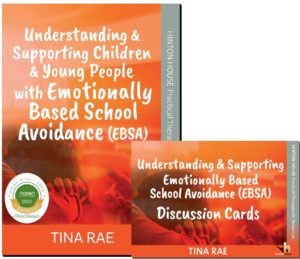
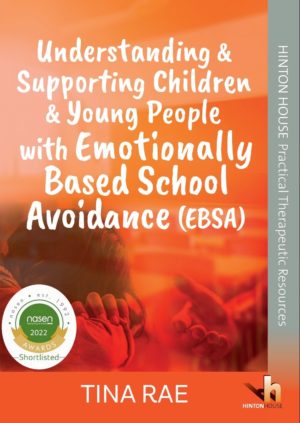
The workbook — Understanding & Supporting Children & Young People with EBSA, shortlisted for the nasen Awards 2022. Includes the EBSA Checklist for early identification, the full risk factor framework, 11 photocopiable handouts for staff and parents, a sample return-to-school support plan, and a step-by-step reintegration process with a strong focus on primary-to-secondary transition.
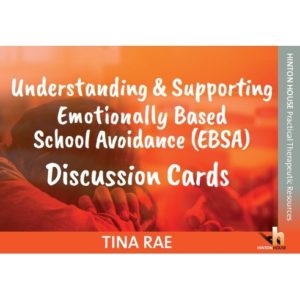
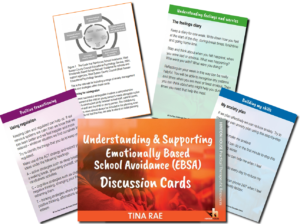
60 Discussion Cards — practical activities helping children name their worries about school and build self-help skills: staying regulated, managing stress and anxiety, getting organised, and accessing the right support.
My Attendance Journal — journalling activities that build the resilience to engage with school, and help a child feel safe, heard and supported.
Plus Tina’s training webinar, included with the set only.

BEHAVIOUR